Million Digits of Pi
The first million decimal digits of π, set out as a short mathematical paper rather than a wall of text, on a domain that is itself π to thirty-two places.
3.14159265358979323846264338327950.com →
The domain is the point
3.14159265358979323846264338327950.com is π to thirty-two decimal places. The
site gives the first million digits after the point, which is where the joke
stops and the typesetting problem starts.
Making a million digits readable
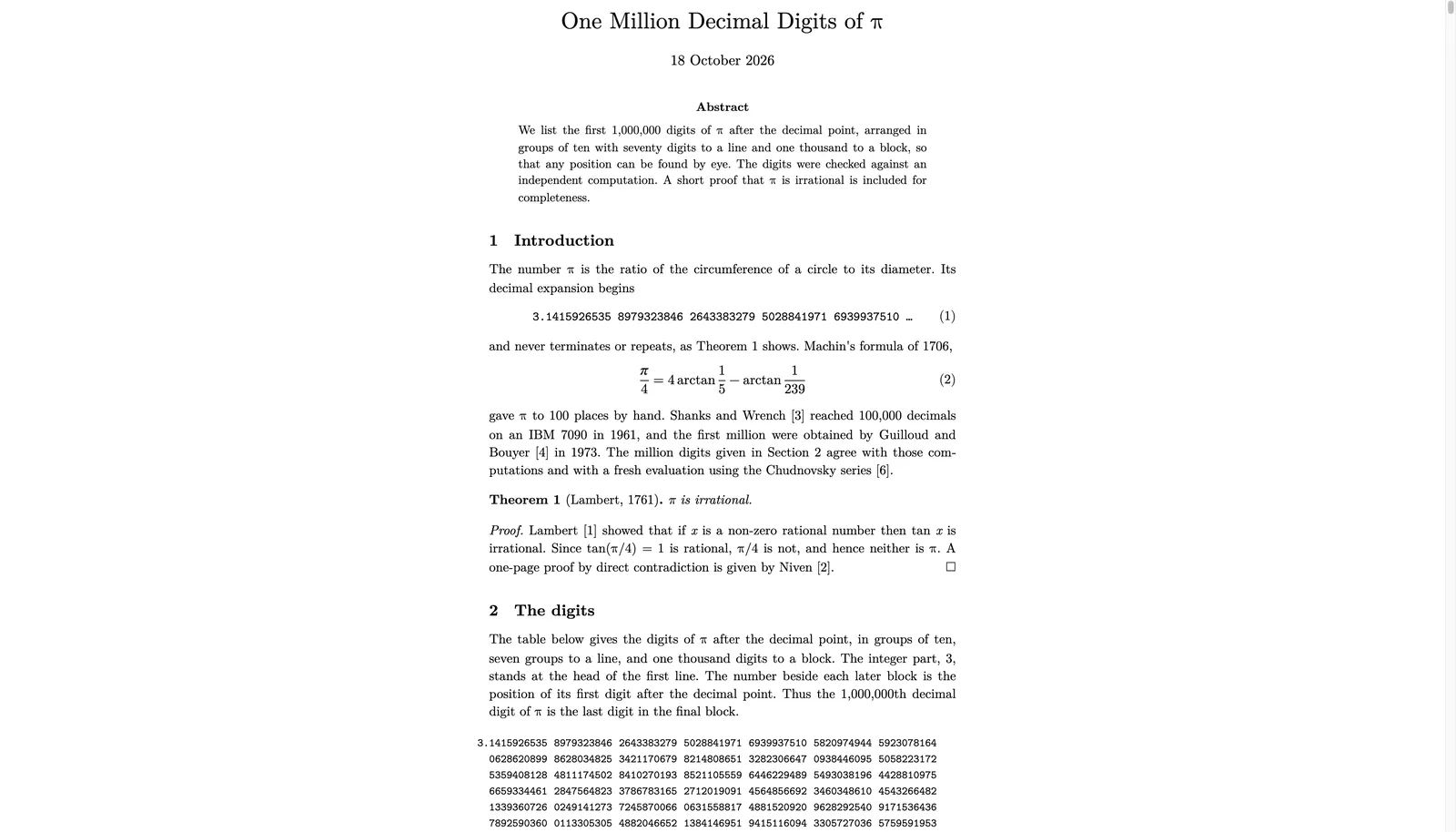
A million digits pasted into a page is unusable. These are set in groups of ten, seven groups to a line, one thousand digits to a block, with the position of each block's first digit printed beside it. That makes any individual digit findable by eye. The integer part 3 sits at the head of the first line and is not counted; the millionth digit after the point is the last digit of the final block.
The digits were computed with mpmath using the Chudnovsky series and checked against an independent evaluation, so the page agrees with Shanks and Wrench's 100,000 decimals from 1961 and with Guilloud and Bouyer, who reached the first million in 1973.
Presented as a paper
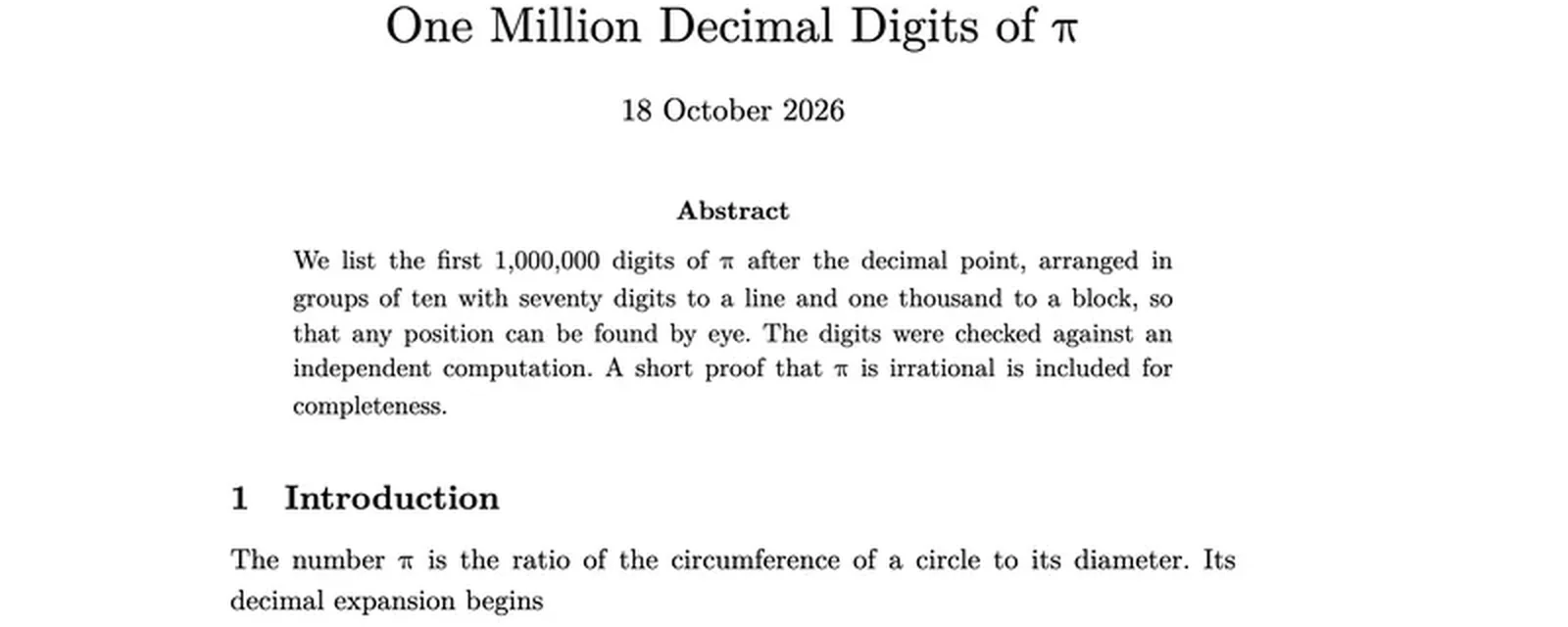
It is laid out as a short paper, because that is the form the content wants: an abstract, an introduction tracing the computation from Machin's formula of 1706 through to the Chudnovsky series, the digits themselves, and real references — Lambert, Niven, Shanks and Wrench, Guilloud and Bouyer.
Lambert's 1761 theorem that π is irrational is included with its proof, which is the detail that justifies the whole exercise: the digits never terminate and never repeat, so a million of them is an arbitrary place to stop rather than an answer.